français
 English
 Deutsch
 italiano
 русский
 español
 português
 العربية
 Nederlands
 한국의
한국의 Romania
 Bulgaria
 Melayu

La soude caustique (NaOH, hydroxyde de sodium) est un produit chimique de base essentiel pour des industries telles que la fabrication du papier, l'alumine, le textile, la chimie, le traitement de l'eau et le nettoyage. Dans l'industrie moderne, la production à grande échelle de soude caustique ne se fait plus par simple neutralisation chimique ; elle repose plutôt sur… électrolyse chlore-alcali Le procédé d'électrolyse de la soude caustique consiste à introduire une saumure de chlorure de sodium de haute pureté dans des électrolyseurs où, sous courant continu, on produit simultanément de l'hydroxyde de sodium, du chlore et de l'hydrogène. Comprendre la production de soude caustique par électrolyse ne se limite donc pas à mémoriser les équations de réaction ; il est également nécessaire de comprendre les interactions entre la qualité de la saumure, les membranes échangeuses d'ions, le rendement du courant, la concentration du produit et la gestion des gaz sous-produits.
Les matières premières de base pour la soude caustique industrielle semblent simples — le chlorure de sodium et l'eau — mais la saumure qui entre dans l'électrolyseur doit être rigoureusement purifiée. Après dissolution du sel brut, elle contient généralement du calcium, du magnésium, du fer et des matières en suspension. Si ces impuretés pénètrent directement dans un électrolyseur à membrane échangeuse d'ions, elles peuvent contaminer ou obstruer la membrane, augmenter la tension de la cellule et réduire la durée de vie de la membrane et des électrodes. Par conséquent, avant l'électrolyse, il est impératif de procéder à une purification rigoureuse. électrolyse de la saumureLe système d'ingénierie est généralement configuré avec des unités de dissolution du sel, de purification primaire de la saumure, de filtration, de purification secondaire de la saumure et de conditionnement de la saumure afin de stabiliser sa composition à l'entrée de l'électrolyseur. Pour les entreprises qui envisagent de construire ou de moderniser une usine de chlore-alcali, la capacité de purification de la saumure est souvent déterminante pour la stabilité à long terme des unités en aval ; il ne s'agit pas d'une simple étape de prétraitement.
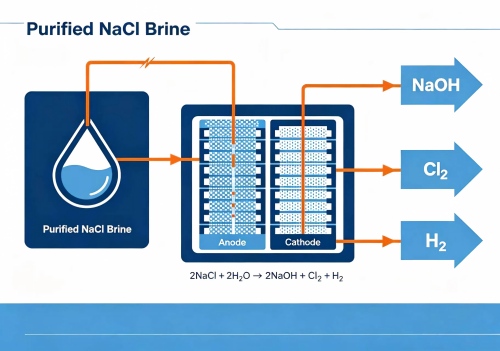
L'industrie moderne du chlore-alcali utilise principalement la technologie d'électrolyse à membrane échangeuse d'ions. À l'intérieur de l'électrolyseur, une membrane échangeuse d'ions sépare le compartiment anodique du compartiment cathodique. La saumure purifiée est introduite du côté anodique, tandis que l'eau ou une solution alcaline diluée en circulation est ajoutée du côté cathodique. Sous l'effet d'un courant continu, l'oxydation des ions chlorure se produit à l'anode : 2Cl⁻ → Cl₂ + 2e⁻ ; la réduction de l'eau se produit à la cathode : 2H₂O + 2e⁻ → H₂ + 2OH⁻. Simultanément, les ions Na⁺ peuvent migrer du compartiment anodique vers le compartiment cathodique à travers la membrane échangeuse d'ions et se combiner aux ions OH⁻ pour former du NaOH. La réaction globale est la suivante : électrolyse du NaCl L'équation peut s'écrire : 2NaCl + 2H₂O → 2NaOH + Cl₂ + H₂. L'intérêt principal de la membrane échangeuse d'ions réside dans sa capacité à laisser migrer les ions sodium tout en limitant au maximum la rétrodiffusion des ions chlorure et hydroxyde, améliorant ainsi la pureté de la soude caustique et évitant tout mélange indésirable de chlore, d'hydrogène et de solution alcaline.
La solution alcaline directement obtenue à partir d'un électrolyseur à membrane échangeuse d'ions contient généralement environ 32 % de NaOH, tandis que la concentration de la soude caustique liquide couramment disponible sur le marché est d'environ 50 %. Par conséquent, l'électrolyse ne constitue que l'étape réactionnelle principale. production d'hydroxyde de sodiumUne ligne de production complète de soude caustique nécessite également des systèmes de circulation de la solution alcaline, de séparation gaz-liquide, de refroidissement, d'évaporation et de concentration. Dans les conceptions courantes, une soude caustique de qualité membranaire à environ 32 % peut être progressivement concentrée jusqu'à environ 50 % grâce à des évaporateurs à double ou triple effet. Si le projet requiert une soude caustique liquide plus concentrée, de la soude caustique en paillettes ou en granulés, des unités d'évaporation à haute concentration et de formation de soude caustique solide supplémentaires sont nécessaires. À ce stade, la consommation de vapeur, le choix de l'échangeur de chaleur, la résistance à la corrosion des matériaux et le contrôle de la concentration influent directement sur le coût du produit final et la stabilité de l'exploitation de l'installation.
La soude caustique n'est pas un produit isolé. Selon la relation stœchiométrique électrochimique, pour chaque quantité donnée de NaOH produite, du chlore et de l'hydrogène sont générés simultanément. Par conséquent, une solution d'hydroxyde de sodium véritablement complète doit prendre en compte simultanément les trois flux de matières. Le flux de chlore nécessite généralement un refroidissement, un dégazage, un séchage, une compression ou une liquéfaction ; le flux d'hydrogène requiert une séparation gaz-liquide, un refroidissement, un lavage, une purification ou une compression, et peut être utilisé pour les chaudières, la synthèse, comme combustible ou pour une alimentation externe, selon les conditions de l'installation. Si l'on ne calcule que la production de soude caustique sans tenir compte du bilan chlore-hydrogène, des problèmes peuvent survenir, tels qu'une absence de consommation de chlore en aval, des rejets d'hydrogène, des systèmes de sécurité insuffisants ou des spécifications d'équipement inadaptées. Par exemple, la taille de l'installation, le volume de saumure en circulation, le courant d'électrolyse, la capacité de traitement du chlore et de l'hydrogène et la charge d'évaporation doivent tous être déterminés dans le cadre d'un bilan matière et d'un bilan énergétique communs. C'est également la principale différence entre les projets industriels et les simples électrolyses de laboratoire.
Lors du choix d'un fournisseur pour un projet de soude caustique, la comparaison des devis d'électrolyseurs ne suffit pas. Des critères d'évaluation plus pertinents incluent la qualité du sel brut et les spécifications du produit cible, la configuration de purification de la saumure, les systèmes de membranes échangeuses d'ions et d'électrodes, la densité de courant et la consommation électrique unitaire, la conception de sécurité pour la production de chlore et d'hydrogène, la consommation de vapeur du système d'évaporation, les matériaux des équipements, les solutions anticorrosion, le contrôle automatisé et la facilité de maintenance ultérieure. Hefei Sinopower Technologies Co., Ltd., via sa marque Rubri (hfsinopower.com), propose une conception systématique de la ligne de production de chlore-alcali, adaptée aux caractéristiques des matières premières du client, à la capacité de production de NaOH visée et à la concentration du produit final. Pour les nouveaux projets, une solution optimale pour la production d'hydroxyde de sodium ne se limite généralement pas à une simple liste d'équipements individuels, mais repose sur une conception globale du procédé. Celle-ci couvre l'ensemble du processus, de l'entrée de la saumure dans l'usine jusqu'à la production sécurisée de NaOH, de chlore et d'hydrogène, tout en prévoyant des marges pour le remplacement des membranes, la maintenance des équipements, l'extension de capacité et l'optimisation de la consommation énergétique. Ce n'est qu'en évaluant le prétraitement, l'électrolyse, le post-traitement et les utilités au sein d'un même système que l'on peut véritablement juger du coût d'investissement, du coût d'exploitation et de la fiabilité à long terme du projet.
Q1 : Pourquoi une ligne de production de soude caustique à membrane échangeuse d'ions nécessite-t-elle une pureté de saumure aussi élevée ?
Les impuretés telles que Ca²⁺, Mg²⁺ et Fe affectent la perméabilité sélective de la membrane échangeuse d'ions et peuvent entraîner son encrassement, une augmentation de la tension de la cellule et une consommation d'énergie plus élevée. Lors de la conception du projet, le schéma de purification primaire et secondaire de la saumure doit être déterminé en fonction de la composition du sel brut, plutôt que de reproduire directement une configuration d'équipement standard.
Q2 : L'électrolyseur peut-il produire directement 50 % de soude caustique ?
Généralement non. La solution alcaline à la sortie d'un électrolyseur à membrane contient généralement environ 32 % de NaOH. Si le client a besoin de soude caustique liquide commerciale courante à 50 %, un système d'évaporation et de concentration doit être mis en place. Le nombre précis d'étages d'évaporation doit être optimisé en fonction de la capacité de production, du prix de la vapeur, des conditions de la source de chaleur et de la concentration cible.
Q3 : De quoi dépend principalement la consommation d'énergie d'un projet de soude caustique ?
Elle est principalement influencée par des facteurs tels que la structure de l'électrolyseur, l'état de la membrane et des électrodes, la densité de courant, la température de la cellule, la pureté de la saumure, la différence de pression entre l'anode et la cathode, et la durée de vie de l'équipement. Les technologies d'électrolyse membranaire avancées visent à réduire la tension de la cellule et la consommation d'énergie unitaire de NaOH, mais dans la pratique, une valeur nominale isolée ne suffit pas ; elle doit être évaluée en fonction des conditions de fonctionnement.
Q4 : Que se passe-t-il si une entreprise souhaite uniquement produire de la soude caustique et n'a pas besoin de chlore ni d'hydrogène ?
L'électrolyse traditionnelle du NaCl produit simultanément du chlore et de l'hydrogène selon les proportions stœchiométriques. Par conséquent, avant l'approbation du projet, il est impératif de prévoir les voies de traitement sécuritaire ou d'utilisation commerciale de ces deux gaz sous-produits. En cas d'insuffisance de capacité de consommation de chlore en aval, la rentabilité globale et le taux d'exploitation de l'usine de soude caustique seront limités. Il s'agit généralement d'un aspect souvent sous-estimé lors de l'évaluation de la faisabilité d'un projet.



 IPv6 RÉSEAU PRIS EN CHARGE